
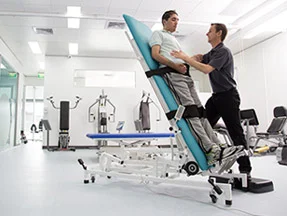
For patients who have been bedridden for long periods, or those suffering from severe neurological conditions like stroke or spinal cord injuries, standing up is a major challenge. Our Tilting Table Unit provides a safe, gradual, and highly controlled way to bring patients back to a vertical position.
Safe & Controlled Verticalization
Under the expert clinical supervision of Prof. Dr. Abeer Elwishy, the tilting table is used as a critical early-stage intervention in neuro-rehabilitation. By strapping the patient securely to the table and slowly adjusting the incline, we allow the body to adapt to gravity without the risk of falling or sudden drops in blood pressure.
Key Benefits of the Tilting Table
- Cardiovascular Adaptation: Prevents orthostatic hypotension (severe dizziness/fainting when standing) by training the blood vessels to adapt to gravity.
- Spasticity Reduction: The sustained stretch provided by standing helps reduce severe muscle spasms in the legs, commonly seen in MS and spinal cord injuries.
- Bowel and Bladder Function: Being in an upright position uses gravity to naturally improve digestion and urinary function.
- Psychological Boost: Allowing a bedridden patient to see the world from a standing perspective again provides massive motivation for their rehabilitation journey.
Frequently Asked Questions
Who can benefit from the tilting table?
The tilting table is highly beneficial for patients recovering from strokes, spinal cord injuries, traumatic brain injuries, and patients experiencing severe muscle weakness or dizziness after prolonged ICU stays.
Is standing on the tilting table safe?
Yes, it is incredibly safe. At our Nasr City clinic, patients are securely strapped to the table using padded belts across the knees, hips, and chest. Our physical therapists constantly monitor vital signs (like blood pressure) as the table's angle is slowly increased.
Take the First Step to Standing
Contact our neuro-rehabilitation experts to learn how we can help you or your loved one safely regain mobility.
Book a Consultation